The Racing Life of Martin Knight
- Jo O'Neill
- Aug 5, 2025
- 10 min read
Updated: Dec 8, 2025
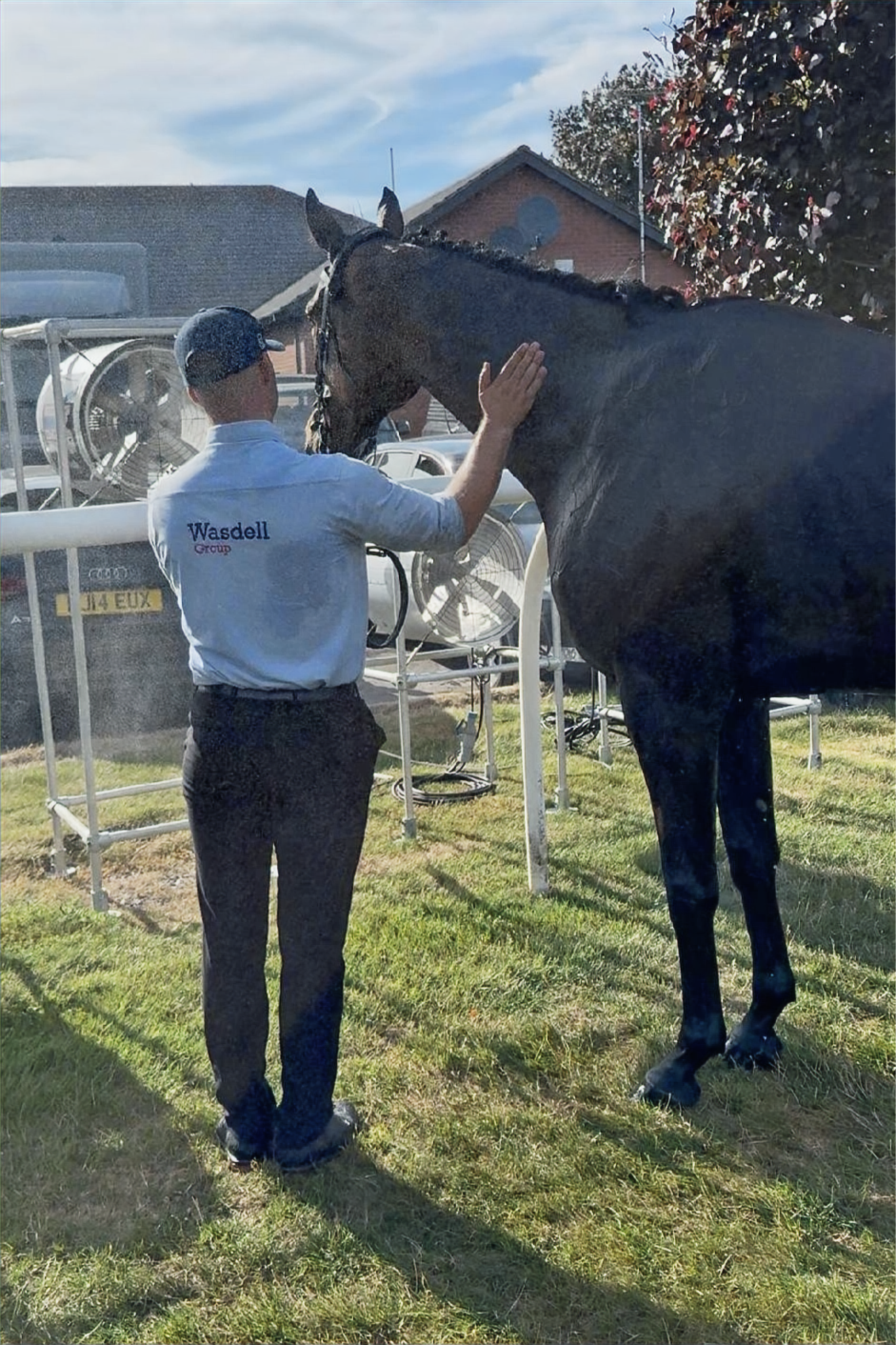
I spoke to Martin Knight the day after he’d worked a particularly hot July meeting at Stratford Races. ‘There was plenty of water, no fatalities, no injuries. Every horse came back safe and sound, touchwood,’ he summed up. A successful day is all Martin asks for after thirty-eight years in his job as an EWIO.
Now semi-retired, Martin attends a race meeting once a week. He works alongside a slowly diminishing band of people who have spent their lives in racing. His fellow EWIOs include Stuart Shilston who rode for the late Queen Mother, Steve Fox was head of travelling for Jenny Pitman, Vincent McKevitt rode over a hundred and fifty winners and Chris Maiden was a top huntsman for the Berkley. Holding his own, Martin was head of travelling for the late Martin Tate for over a decade. He was leading up Cheltenham Festival winners before many of today's stable staff had even been born.

Martin parading Bawnouges before he won the 1978 Mackeson Gold Cup
Racing also introduced Martin to his wife Sarah (nee McDonagh), who he married in 1991: ‘We first met at the Whitbread Gold Cup meeting in 1985. Sarah looked after Broad Heath, I had Scot Lane and Steve Fox was there with Corbiere. We all stood in the stable lads’ podium and watched the race together.’ Sarah also worked for top trainers such as David ‘the Duke’ Nicholson and was head girl for Robin Dickin.
Their daughter Tori spent time with David Bridgewater and Fergal O'Brien, and now rides out for Charlie Hills. Over the last couple of years, she has taken Hills’ runners to Australia and the USA. Son Jack used to hunt and was a member of the Pony Club with Tori, and now has a butchery business in Stroud. Youngest daughter Grace is the complete opposite to the other two and, having graduated from Portsmouth University, is a dental hygienist and therapist.
Over the past thirty years, they’ve owned a series of terriers, the latest one being Benny the Jack Russell.
Martin and Sarah live in Broadway on the edge of the Cotswolds. ‘I’m a Worcestershire boy through and through,’ explains Martin, 68. He was born in Evesham, moved to Kidderminster and onto the small village of Cookley, where his father was the village policeman.
I could’ve listened to Martin’s stories for hours – his memories so vivid that I felt I was back in those long-ago days. ‘I've enjoyed every minute,’ he said reflectively. When Martin fully retires, racing will have lost its most loyal and dedicated servant.
Did you have a horsey childhood? I had a grey pony called Cobweb and used to show jump. There wasn’t the Pony Club as such in those days and, without laptops or anything like that, I went out on my bike and then rode my pony. I did my paper round on my pony and the villagers fed him Polo mints or carrots when I left him tied to garden gates!
How did you get into racing? My dad was the bobby for all the local villages and nearby was the trainer, Martin Tate. Dad looked after Mr Tate’s place when he was on holiday and Dad kept pestering him about me wanting to work in racing. Just to keep him quiet, Mr Tate said to bring me up on a Saturday morning. In 1973, when I was sixteen, I left school and went there in the July. I stayed at Mr Tate’s until I started working for the Jockey Club.
What roles did you have? I started at Mr Tate’s as a lad and, in ’77, the travelling head lad was kicked whilst riding out and broke his leg. Mr Tate gave me the first travelling, which I did for twelve of the fifteen years I worked there.
Were you a jockey? In 1978, I had my first ride in a hurdle race at Ludlow on a grey called Drifting Smoke for Mr Tate. A certain Mr Peter Scudamore rode another grey, called Bright Fergus for his father Michael. We both claimed seven pounds – I was a conditional and he was an amateur. He beat me!
I never really wanted to be a jockey. I was quite tall and liked my food too much so it was a struggle to do 9.7 or ten stone. Mr Tate asked if I wanted to renew my license but I was doing the travelling by then. I’ve kept the cuttings from The Sporting Life of all of my six rides.

Martin leading in Scot Lane after winning the 1982 Ritz Club Chase at the Cheltenham Festival
What were your best days at Martin Tate’s? In 1977, I led up my first Cheltenham Festival winner with Water Colour, who won the Joe Coral Final as it was known in those days.
I led up another two Festival winners in ’82 and ’83 with Scot Lane. He won the Ritz Club Handicap Chase twice. The Boss and myself wanted him to run in it again in ’84 but the owner insisted he run in the Gold Cup, and he finished fourth to Burrough Hill Lad. He ran so much better than we thought and got as much prize money for fourth than winning a third Ritz Club.
I also led up the winner of the 1978 Mackeson Gold Cup (now the Paddy Power) with Bawnogues, ridden by a young Craig Smith. He was bred by the Lawlors of Naas who also bred Mill House and owned much of Punchestown Racecourse. The following year, I was on the front cover of Horse & Hound with Bawnogues, and I’ve still got the race card from the year he won and the year after when we were on the inside cover. I was 21 and typical ‘70s: the Paisley shirt and tie, leather jacket and the big hairstyle.
Favourite jockey: David Mould, who used to ride for Peter Cazalet and was one of the Queen Mother’s jockeys.
Favourite racecourse: Believe it or not, my favourite has always been Newton Abbot. When I was doing the travelling, the M5 only went as far as Bristol so we had to drive through Bridgewater and go overnight. Before the big Tesco’s was built opposite the racecourse, there was a row of terraced houses where us lads would B&B.
Favourite former racecourse: Not too many have shut since I’ve been in racing. Folkestone was one but, I must say, I wasn’t sad to see that go! Hereford shut but it reopened again. The one that upset me was when they did away with jump racing at Nottingham. It was a good, flat track and all the top trainers sent their good horses there, especially before the Cheltenham Festival. They even had a Champion Hurdle trial there, which we won with Flash Imp. He went onto finish fourth in the Champion Hurdle itself.
Favourite meeting: It’s at Cheltenham but not the one you’d think – the November meeting. My favourite three days of the year.
Favourite Cheltenham Gold Cup winner: Of all the Gold Cup winners I've seen, it has to be Kauto Star.
Favourite Champion Hurdler: The one that stands out is Istabraq.
Favourite racehorse: I loved the ones I had at Mr Tate’s. Scot Lane and Bawnogues were practically equal but Bawnogues was slightly ahead because he was better class, and I used to ride him religiously and look after him.
Racing hero: By far, it was Lester Piggott. From the age of six, I followed and idolised him.
During the late ‘60s and ‘70s, when the Epsom Derby was held on a Wednesday, I thought Vincent O'Brien was the best trainer that's ever been. I remember all his good horses like Nijinsky, The Minstrel, Sir Ivor and Roberto.
As a horseman, the best hands had to be John Francome.
How has working in racing changed? There's been a lot of changes, not all for the best.
It's seven days a week and it's too much. If you're a young man with a family, it's hard. When I was younger, the kids were in bed when I left for work in the morning and when I got home at night. In ’88, when I started working for the Jockey Club on a full-time contract, there was no Sunday racing, all-weather racing, morning racing or summer jumping. National Hunt finished in June at Stratford and started again in August at Newton Abbot.
I'm not a fan of summer jumping but it is what it is. I am of the opinion that horses and lads need six weeks off. In the future, they’ll look into summer jumping – I doubt they’ll do away with it completely but it might get reduced.

The EWIO Team at the 2022 Cheltenham Festival
Describe your EWIO role? EWIO stands for Equine Welfare Integrity Officer. We protect the integrity of the stables, scan horses to make sure the right one has turned up (you'd be amazed at how many times the wrong one has come to the races). Our role now covers the sampling of racehorses, yard visits, point-to-pointing and patrols. Having made sure that the right horses arrive, we then scan horses out again to make sure the right horse goes out for the right race. It's also amazing how many people come out for the 3:30 instead of the 4:30.
At the big meetings, we do baggage checks to advise people about what medication they can bring in and out of the yard. We basically try to make everything run smoothly.
How has your job changed over the years? When I started, there were two separate departments. Veterinary Technicians (VTs) mostly consisted of ex-army out of the veterinary corps and solely dope tested. Stable Security had to make sure everyone signed in and we’d check their identity – only people with a valid card could enter. Back then, if you didn't have a card then you couldn't come in but since COVID, trainers don't have passes and people can come in with an e-mail to say theirs have been applied for. Also, since COVID, passes are scanned on the grabber making it very easy.
When they merged the departments, we all had to reapply for EWIO roles and had interviews at Wolverhampton Wanderers football ground, which was a bit odd because I'd been on the job twenty-five years by then. Thankfully, I got the job and have worked in the same role for the Jockey Club when it ran the whole of racing, HRA, BHB and now the BHA.

Most bizarre day as a head of travelling: There was a very bizarre incident in ’78, which would never happen nowadays with mobile phones and the internet. Whilst I was driving down the M5 on the way to Newton Abbot, it came over Radio 2, on Terry Wogan’s daily morning sports report, that racing at Newton Abbot had been abandoned. So, I pulled in at the next motorway services. The trainer Derek Hayden-Jones’ lorry was parked up with his travelling lad Keith Huntley. We had a coffee and turned for home. On arriving back, Mr Tate asked what I was doing then rang the racecourse, who confirmed it had been a hoax. Someone had rung in and had it announced on air. Our runners, amongst others, were withdrawn as it was too late to set off again.
It all was written about in a book called The Strangest Tales of the Turf.
Most bizarre day as an EWIO: When I was working for the Jockey Club in 1994, I was on the night shift at Bangor and went to the stable yard to fill the kettle up. I heard a crackling noise and presumed the nearby farm was having a party with fireworks – but it continued. So, I poked my head round the corner to have a better look and there were flames coming out of the store shed, crackling up through the asbestos roof.
I rang the fire brigade who came from Wrexham and took ages. The firemen pulled off the first couple of shaving bales and put the fire out. When they left, they asked if I could douse the embers with the yard’s fire hose, which I did. It transpired that, after a delivery, the bales had been stacked up to the light, which had been accidentally left on. If you open the store door, you can still see the scorch marks around the light. I got a nice letter off Lord Zetland thanking me preventing a nasty fire from spreading and endangering the twelve horses staying that night. I've never forgotten the date. It was the night of Friday the 13th in May.
How secure is the future of racing? Personally, I think the fixture list is overloaded. If the betting tax comes in, which I hope it doesn't, it would be a very bad thing. Flat racing is probably more secure than jump racing, but I think the premier jump meetings will still happen. It probably won't happen in my lifetime but in twenty years, a couple of smaller jump tracks could fall because racing won't be sustainable with the prize money as it is. For instance, in the ‘70s, we were winning sellers for more money than what some of these races are worth now.
What do you love about racing? I love meeting all the nice people, which is why I decided to work fifty days to see my colleagues and everyone in racing. I still like seeing the horses and travelling to the racecourses.
The people are what I love most about racing. A lot of the jockeys I led up are now trainers, like Jonjo O’Neill, who's the same now as he was then. Over the years, because children under sixteen aren't allowed in the stable yard, I've entertained the Bowen boys who used to play football, Billy Loughnane and Hollie Doyle. There are probably a few more I’ve looked after in the office, and I've enjoyed watching them grow up to become champion jockeys.

EWIOs Martin Knight, Alec Dent and Jez Willis
What do you look forward to about fully retiring? We’re grandparents to Jack’s kids, two-year-old Maximillian and six-month-old Polly, so they'll keep us busy.
Favourite meal: You can't beat a good old roast dinner on a Sunday. We like eating out and, if we celebrate a special occasion, we go to the Old Butcher’s in Stow-on-the-Wold, which is top class. We holiday in France quite a lot so like French food.
Favourite drink: A gin and tonic.
Favourite snack: When I'm back late from racing and don't want a fully cooked meal, I'll have cheese on toast.
Favourite holiday destination: La Rochelle in France.
Favourite film: It's a Maureen O'Hara and John Wayne film – The Quiet Man – but it's not a western.
Favourite book: I'm not really a reader but I'm halfway through a book from the 1900s about a racing yard near Salisbury, called The Druids Lodge Confederacy by Paul Mathiew. It's about a businessman, a bookie and gambling.
Favourite music: I'm a great fan of The Electric Light Orchestra (ELO).
Other hobbies/interests: I'm a bit of a twitcher – I'll take the bins out and do a bit of bird watching. Sarah and I go walking with the dog a lot.


Comments