The Racing Life of Dr Deborah Butler
Updated: Jan 14
Whilst growing up Bishop’s Itchington, Deborah Butler was part of a family that was involved in racing. She used to borrow her cousin’s pony whenever possible, and always had a love of sports and being active – ‘I was very sporty at school – hockey, athletics and everything a girl was allowed to do back then in the 1970s,’ she says. So, perhaps this racing background and all round sportiness nudged Deborah towards a career in racing…

Decades and a doctorate later, no one has given racing more than Deborah. Known as Deb, she has worked for many successful Flat and National Hunt trainers as a groom, rider and driver. Nowadays, she describes her role as ‘general dog’s body’, which humbly describes riding out, clipping and everything else, at Martin Keighley Racing but her input in the yard – and to the racing industry – is much larger.
After turning to studying, Deb climbed through the levels until she achieved a PhD in Sociology, Social History and Anthropology. She worked at the Universities of Warwick and Hull and the British Veterinary School, and now as a tutor for the British Racing School’s Foundation Degree in Horseracing.
Deb, 66, is married to husband Ross and splits her time between Stockton and Moreton-in-Marsh. She has two daughters, Alexandra, 35, and Katie, 31, five dogs and two fat ponies.
Did you have a horsey childhood? Yes, in that I used to borrow my cousin’s pony, a 12hh called Chunky. On holidays in Wales, I also used to ride ponies at a riding stables and led hacks out up on the hill, aged eleven!
At twelve, I had my own pony, Easter Parade, a four-year-old Thoroughbred 14hh mare who was a bit of a handful. She was very temperamental and not perhaps the right pony for a young novice, but I loved her.

How did you get into racing? Through my family who farmed and hunted. My mum had four brothers who all rode as jockeys and my grandfather used to take us racing.
What trainers have you worked for? Captain J. H Wilson – stable lad then travelling head lad.
David Nicholson – a lad.
I moved with David Nicholson to Jackdaws Castle, so I also worked for Alan King and Richard Phillips. I have also ridden out for Claire Dyson and Kim Bailey, who I also occasionally did the travelling for.
At Martin Keighley Racing, I am a general dog’s body and part-time everything.
Were you a jockey? I had five rides as an amateur in 2005.
Favourite racehorse: Mozzaro as he is such a kind horse.
Favourite racecourse: Not sure as I enjoy most of them, but Ayr does have lovely facilities.
Is there a racecourse you wished that hadn’t shut? I loved Towcester as it was unique.
Deb and her favourite Mozzaro
Favourite meeting: I love Boxing Day racing as there are so many meetings to watch. I do enjoy Royal Ascot as the creme de la creme of horses run.
Favourite jockey: James Best.
Best ever racing celebration: After Charter Party won the Cheltenham Gold Cup.
What do you love about racing? The camaraderie. The non-politically correctness of it all in the yard.

How has working in racing changed for the better? There is more recognition of staff and slightly better regulation and pay.
And, for the worse? Cutting corners, staff shortages and certain aspects aren’t followed up on.
In your opinion, why did the staffing crisis in racing occur? This has been ongoing since the 1960s when the supply of small lithe young men started to dwindle. I have heard racing described as feudal, a master-servant arrangement where the servants are there to serve for little recognition or reward. Also, a lack of awareness by those in power that employment relations were important and staff should be valued.
Women began to be employed in yards to fill the gap, although these pioneering women had to stand their corner as not all those involved with racing thought women should be involved; instead they should at home, making the tea! After employing women, the racing industry turned to migrant labour, who were some cheap labour.
Nowadays, the division of labour in yards has changed. Previously the role of the ‘lad’ was a composite one where work was both mundane and specialised and skilled. Through staff shortages yards typically employ yard people and ‘work riders’ who may only do a morning.
To sum up, there was a lack of investment in staff and their needs, wages and no proper career structure. In general, the population has been getting heavier and better educated with more openings in other occupations with better pay and employment conditions.
Advice for people wanting to come into racing: The hours are sometimes longer than expected and there are not always pleasant working conditions, so you must be tough and want to work.
Why did you start studying? I had cocked up A-levels but had had a decent education. I was not going anywhere in racing, which had become mundane and repetitive. So, I completed an Access to higher education course. This continued on to a BA (Hons) at Warwick University, an MA at Warwick and a PhD at Warwick on Indentured and Modern Apprenticeships in the Horseracing Industry: A Gendered Analysis.
What had this led to? Academic jobs at Warwick University, Hull University and Bristol Veterinary School. I am now attached to Hartpury University who validate the foundation degree and BSc (Hons) Horseracing offered by the BRS.
Describe how education is now present in racing: There are more short courses, NVQs, and Mental Health Awareness, first aid and mentoring courses.
There has been a foundation degree in horseracing, which is now a BSC (Hons) in Horseracing, that people can study for two years whilst working in a yard in which modules run every month. They do three trainers’ modules plus the Racing Industry Course, which is a week-long, prestigious course in its own right.
What are the best points to studying for a degree? It broadened my knowledge of wider subjects such as social policy, gender, work and employment.

Were there any limitations? Only those created through having small children when trying to study but I found ways round it.
Advice for anyone in racing who wants to get into higher education: Go for it. It is tough but will further your career.
Favourite meal: Lasagne and salad.
Favourite drink: Soft drinks.
Favourite snack: Tunnock’s biscuits!
Favourite film: The Sound of Music.
Favourite TV program: Shetland.
Favourite book: I’ve never really finished a book…
Favourite music: Classical and Brandi Carlile.
Other hobbies and interests: Cycling, running, watching rugby, some football, tennis, listening to cricket on the radio, major sporting events, opera and comical plays.

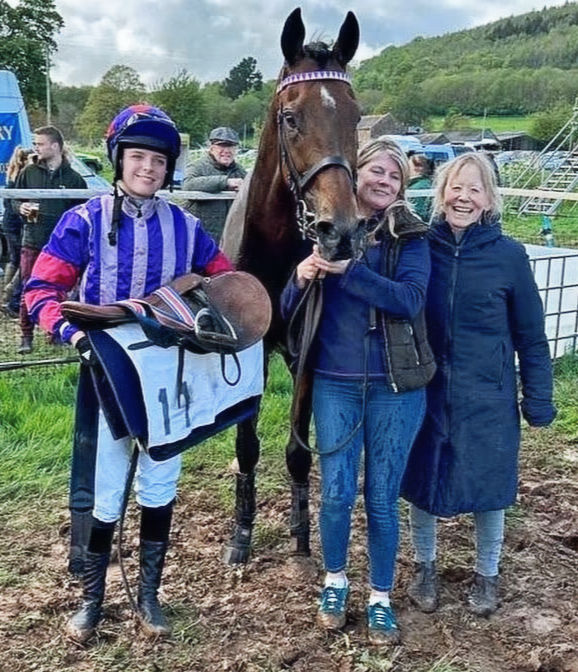
With a victorious Postponed Legacy at Uttoxeter in January '26


Comments