An Interview with Davide Russo, Founder of Horshare
‘I am based in Milan, Italy, but most of my work happens wherever horses, people and racing cultures meet,’ explains Davide Russo.

He is the founder of Horshare, an innovative platform that hopes to connect people within the racehorse industry. Be it owners searching for a horse or breeders or trainers wanting to sell shares – Horshare wants to be the lynchpin connecting these through its ‘digital ecosystem’. Davide, 28, strives to bring racing into the modern era, whilst adhering to utmost integrity.
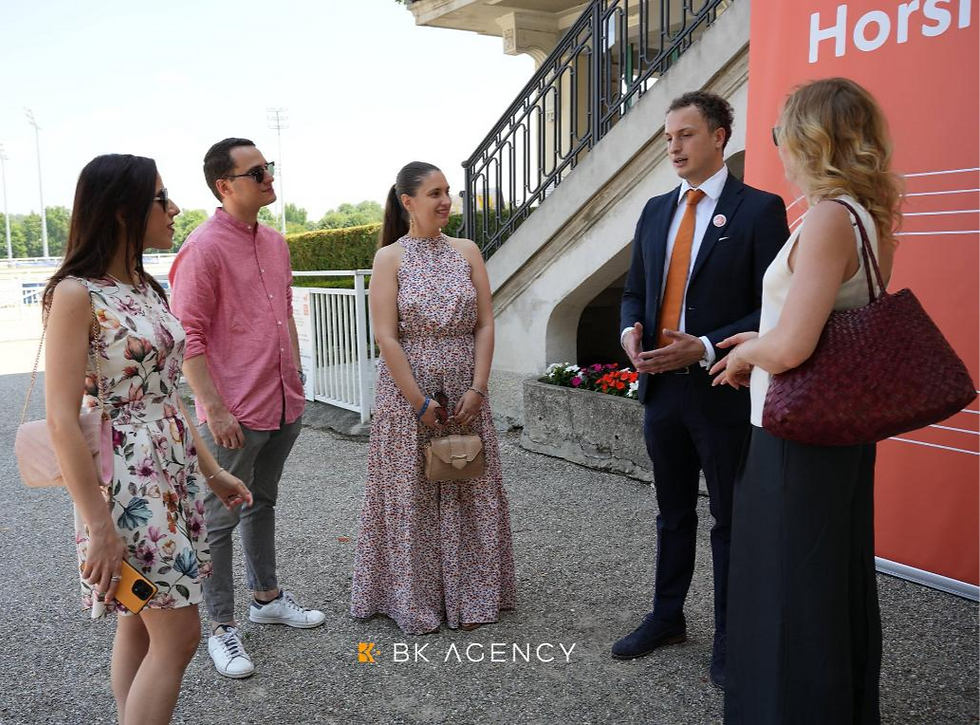
As Davide’s love of racing as a sport grew so did his desire to revolutionise the traditional exclusivity and broaden racing’s opportunity to apply to everyone. So, in June 2025, Horsehare was fittingly launched at the Oaks di Milano race day. The day brimmed with sunshine and promise of Horshare’s successful future ahead.
To get in touch, please contact Davide or his team through the official Horshare channels or directly via the website www.horshare.club or email info@horshare.club.
Where did your interest in horses and horse sports come from? I didn’t grow up around horses, and I never rode as a child. I entered this world later, almost as an outsider and I think that shaped everything that followed.
I was introduced to horses through people who worked with them professionally. What struck me immediately wasn’t the glamour of racing, but how complex, fragmented and often misunderstood the industry really was. I realised that behind every race there are layers of decisions, responsibility, trust and human effort that rarely get told properly.
That curiosity slowly became a commitment.
Do you go to the races? Yes, often. For me, going to the races is never just about watching. It’s about understanding how the sport lives beyond the track.

Favourite racecourse: San Siro in Milan. It was the first racecourse I ever experienced, and it taught me that a racecourse is not just a venue, but a place where memory, culture and sport overlap.
Favourite day’s racing so far: The Dubai World Cup left a strong impression on me. Not only because of the racing quality, but because it showed how racing can become a global language when it is presented with care and vision.
Favourite racehorse: I’ve always been drawn to horses whose stories go beyond performance alone. horses that were doubted, underestimated, or misunderstood before proving their worth. Those stories say more about racing than any statistic ever could.
Favourite jockey: I admire jockeys who are thinkers as much as athletes who understand when not to force a situation, who listen to the horse, and who know that judgment matters as much as courage.
Racecourse worldwide you would most like to visit: Happy Valley in Hong Kong fascinates me. It represents how deeply racing can be woven into everyday life, not just reserved for insiders.
What do you love about racing? Racing doesn’t tolerate shortcuts. You can’t fake preparation, patience or respect for the horse and sooner or later the sport makes that very clear.

I love that racing is a discipline of relationships: between horse and human, between instinct and structure, between ambition and responsibility. When it works, it’s honest in a way few sports are.
Please describe your initiative Horshare: Horshare was born from a simple observation: the horse world is rich in knowledge, passion and history, but poor in shared structure.
Information is scattered. Reputations are often local. Opportunities don’t always travel as far as they should. Horshare exists to bring clarity to that complexity, not by changing the soul of the industry, but by giving it a clearer framework to operate within.
It’s a digital ecosystem designed to make horses, people and their work easier to understand over time, without stripping away the human element that makes this world special.
What are your aims with Horshare? The aim is not to accelerate the industry, but to stabilise it. In particular:
- To help good work become visible.
- To reduce noise and confusion.
- To create continuity where there is fragmentation.
If people can make better decisions (with more information and less guesswork) then the entire ecosystem becomes healthier.
Who are you aiming Horshare towards? People who care about horses and want to be part of this world responsibly.
That includes experienced owners and professionals, but also those who are curious, respectful newcomers looking to understand racing properly before participating in it.
What equine sports do you deal in? Our focus today is on racing, because it is where structure, ownership and long-term decision-making intersect most clearly. Any future expansion will follow the same principle: respect first, growth second.
What racehorses have you been involved with so far? My involvement has never been about collecting horses, but about learning from them. Being close to decision-making, understanding careers, and observing how choices shape outcomes over time.
How has racehorse ownership changed over the years? Ownership has become more accessible, but also more distant.
While shared models have opened doors, they have sometimes created gaps between owners and the horses themselves. Information travels faster, but not always better. The result is a system where participation has grown, but understanding hasn’t always kept pace.

Can you predict which direction racehorse ownership will go in the future? I think ownership will continue to evolve in two directions.
One will be more passive, more removed. The other will be more conscious, more demanding, and more involved.
The future of racing depends on which of these two paths becomes the cultural standard — not just the economic one.
What are your hopes for Horshare in the future? I hope Horshare becomes something people trust without needing to think about it. A quiet reference point. A place where histories make sense, where reputations are earned over time, and where horses are treated as living stories and not assets to be rushed through a system.
If Horshare helps the industry become clearer without becoming colder, then it will have done its job.


Comments